Game Talk: Hochschule Darmstadt
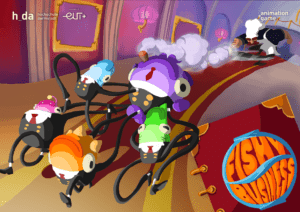
FISHY BUSINESS
Fishy Business unfolds in a luxurious 1980s-inspired restaurant, where, in the midst of it all, four fish mafia members are on a very important mission: they must rescue their beloved Cod Father, who has been brutally kidnapped by none other than Pierre Pecheur, an evil French chef. Due to his past as a fisherman, he has developed an obsession fueled by hatred for the underwater world. In anticipation of revenge, he has turned his restaurant into a puzzle-filled trap in the hope of eliminating the mafia family once and for all. However, he has underestimated the most important rule: in the world of the mafia—fish or not—family always comes first.
In the presentation, students of Hochschule Darmstadt will discuss the making of Fishy Business, a 4-player local co-op game with platformer and puzzle elements aimed at players of all ages and skill levels.
The game was created as part of a semester project. The presentation will cover the design approach, including world and character building, visual explorations of the environment, and the overall artistic inspiration. In addition, the technical aspects of the game, as well as level and game design, will be briefly addressed, with a focus on the trial-and-error process, limitations, and workarounds that shaped the production.
Finally, project management aspects will be discussed, including the approach to coordinating a five-person team and the key learning outcomes.
At the end, participants are invited to solve puzzles together, leave no one behind, and most importantly—don’t get COD(caught)!
HATE THE SIN
Hate The Sin is a first-person narrative deduction game that puts the player in the role of a 1910s priest in the American South. Armed with holy tools, divine authority, and a gun, the task is to “cleanse” a small town by judging its sinners. Across three rounds, ten unique characters are interrogated using dialogue and a set of investigative tools to untangle their confessions.
The game moves away from traditional “whodunit” investigative gameplay. Instead of only determining who committed a crime, the player is forced to judge the “roots” — the underlying human flaws that led to it. Drawing inspiration from Papers, Please, Dante’s Divine Comedy, and Tarantino-style Southern Gothic, the game measures success not by how quickly a case is solved, but by how much hesitation it provokes. It is a mechanical puzzle designed to create internal moral conflict, rewarding insight and adaptability over quick reflexes.
Ultimately, the game explores the destructive potential of absolute authority. A gameplay loop is built that feels routine, yet is constantly disrupted by the messy and subjective nature of human experience. The game does not aim to prescribe a stance on religion; instead, it places the player in the role of judge, jury, and executioner, forcing them to confront that responsibility. By keeping the interface simple and the narrative layered, a space is created in which a central question remains: What really defines a sin, and who actually has the right to punish it?